

Recently, a local pastor was accused and arrested for molesting four children. He was later released and the case was dropped for lack of evidence.
And to be honest, I'm not sure how I feel about all of it.
I think that's actually the point.
I don't know if he's guilty.
I don't know if he's innocent.
And neither does almost anyone commenting on it.
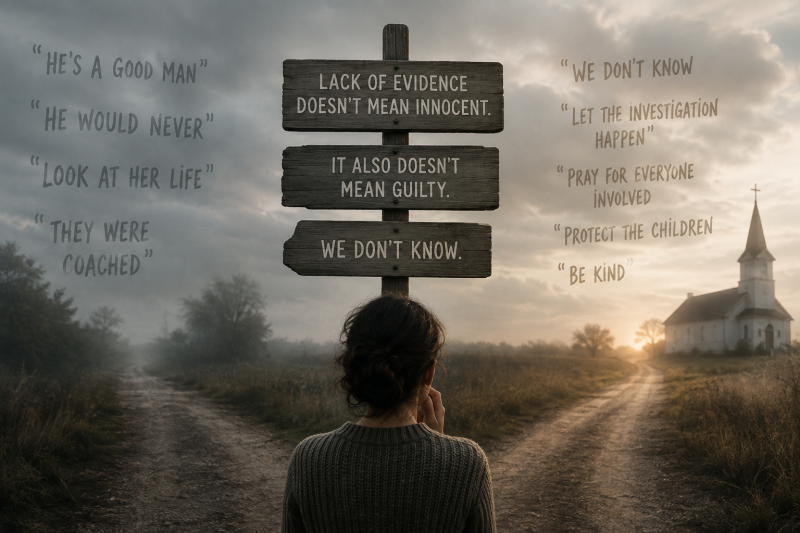
Lack of evidence doesn't mean someone is innocent. But it also doesn't mean they're guilty. It means there wasn't enough evidence to move forward with the case. And sometimes that's all we're ever going to know.
I know that's not a satisfying answer. We want there to be a clear good guy and bad guy. We want to know who we're supposed to believe and which side we're supposed to stand on.
But sometimes we just don't know.
For the people who love this pastor and believe completely in his innocence, I'm sure this feels like a blessing. Maybe even a testimony. They prayed, the charges were dropped, and someone they love gets to come home and try to put his life back together.
I can understand that.
But I also know what this looks like from the other side.
For those of us who have been abused, especially those of us who have watched our abusers or other abusers never face consequences, cases like this can poke at scars we thought had healed.
And for me, it isn't even necessarily about the charges being dropped.
It's about everything that happened around them.
Before anyone really knew what happened, people were already saying he couldn't have done it.
They knew him.
He was a good guy.
He was a pastor.
He was a man of God.
He would never do something like that.
And I kept thinking...
How do you know?
Not, “How do you know he's innocent because I think he's guilty?”
I mean literally: how do any of us know another human being well enough to say what they are or aren't capable of doing when we're not there?
We don't.
I have people I love with my whole heart. People I trust. People I would probably struggle to believe horrible things about.
But I still don't know every thought they've ever had. Every decision they've ever made. Every moment of their lives when I wasn't in the room.
We all have secrets.
We all have sins.
We all have parts of ourselves that other people don't see.
That's a side effect of being human.
That doesn't mean everyone is secretly a monster. And it absolutely does not mean this pastor is guilty.
It just means that “I know him” isn't proof.
And I think the church has to be really, really careful with that.
Because we've heard “he would never” before.
We've heard it about pastors.
We've heard it about youth leaders.
We've heard it about fathers and husbands and teachers and coaches and respected men in the community.
And sometimes...
They did.
That's the uncomfortable truth.
Good people can be falsely accused.
And people who seem good can do terrible things.
Both of those things are true at the same time.
Which is why maybe our first response shouldn't be certainty.
Maybe it should be humility.
What bothered me even more was watching the conversation turn toward the children and their mother.
They were coached.
Their mother was a drug addict.
Look at her life.
Look at her choices.
And maybe there are details of this case that I don't know. I'm sure there are. I wasn't part of the investigation, and I'm not pretending to have information that I don't have.
But using a mother's addiction as an arrow to poke holes in the validity of her children bothers me deeply.
Because what does her addiction prove about what happened or didn't happen to those children?
And what message does that send to everyone else watching?
Because survivors are watching.
That's the part I don't think people realize.
When something like this happens in a church or a community, the people involved aren't the only ones listening.
There are people sitting in those pews who have been abused.
There are people who have never told anyone.
There are adults who were once children nobody believed.
There might even be a child listening right now, trying to decide whether it is safe to tell someone something.
And they're hearing us.
They're hearing us say:
“He would never.”
“I've known him for years.”
“He's a man of God.”
“Look at the kind of family those kids come from.”
And what are we teaching them?
That if the person who hurts you is loved enough, respected enough, Christian enough, or important enough, we're going to have a really hard time believing you?
That's what bothers me about all of this.
The church didn't have to declare him guilty.
They shouldn't have.
But they didn't have to immediately declare him innocent, either.
They could have said:
We love him. We don't want to believe this happened. But we weren't there. We don't know. These are children and these are incredibly serious accusations. We're going to let the investigation happen. We're going to pray. We're going to protect the people involved. And we're not going to tear anyone apart while we wait for answers.
Wouldn't that have been enough?
Now the case has been dropped and he's been on the news talking about being vindicated and telling his side.
And this is another place where I have complicated feelings.
Because part of me thinks... if I were accused of something horrific that I didn't do, wouldn't I want to scream my innocence from the rooftops?
Probably.
Wouldn't I want my name cleared?
Of course.
So I understand it.
But there's another part of me that wishes there was just a little more humility surrounding all of this.
A little less celebration of being “proven innocent,” because unless there is information I'm unaware of, that's not really what happened.
There wasn't enough evidence to continue the case.
That matters.
Due process matters.
The presumption of innocence matters.
But it still leaves us with something we don't like very much:
We don't know.
Maybe he's completely innocent.
I genuinely hope he is.
Because if he is, that means four children weren't abused in the way that was alleged. And that is an outcome worth hoping for.
But I can't say he's innocent because I don't know.
And I can't say he's guilty because I don't know.
What I can say is that the way we respond to accusations like these matters.
Especially in the church.
Maybe the question isn't, “Whose side are you on?”
Maybe the question is, “How do we behave when we don't know?”
Can we support someone we love without destroying someone else?
Can we believe in due process without victim blaming?
Can we acknowledge that false accusations happen while also acknowledging that abuse happens in places we never imagined it could?
Can we stop treating someone's title, reputation, ministry, or relationship with God as evidence?
Can we just admit that sometimes we don't know?
Because I think there is something incredibly dangerous about filling in the blanks with whatever answer makes us feel safest.
“He could never do that” makes us feel safe.
Because if we can tell who the bad people are by looking at them, then maybe we can protect ourselves.
But life doesn't work that way.
Sometimes terrible people look terrible.
Sometimes they look kind.
Sometimes innocent people are accused of horrible things.
Sometimes guilty people are loved deeply by people who genuinely have no idea what they've done.
And sometimes a case ends without giving the rest of us the answer we're desperately looking for.
Maybe this is one of those times.
I don't know.
And I'm learning that maybe “I don't know” isn't a weak answer.
Maybe it's the most honest one I have.
What I do know is that survivors are listening to how we talk about these things.
Children are listening.
People carrying stories they've never told anyone are listening.
And if we're going to call ourselves the Church, I hope we can become a place where our response tells them:
You will be heard.
You will be taken seriously.
We won't decide someone's guilt before we know what happened.
But we won't decide you're lying simply because we love the person you accused, either.
We don't have to know everything to choose compassion.
And we don't have to destroy one person in order to stand beside another.
Add comment
Comments